Best Energy-Efficient Blenders for Smoothies: 5 Ninja Picks That Work
On this page 9 sections
- Side-by-Side Comparison
- The Best Blenders for Thick, Spoonable Smoothie Bowls
- Why Smoothie Bowls Need More Than a Regular Blender
- How to Choose: Power, Bowl Maker, and Capacity
- Smoothie Bowl Recipes That Actually Work in These Blenders
- Energy Use and Noise: What to Expect
- Which Blender Fits Your Kitchen and Routine
- Before You Buy: A 5-Point Checklist
- Questions People Ask
Side-by-Side Comparison
| Rank | Model | Best for | Power (peak watts) | Bowl maker | Capacity | Price |
|---|---|---|---|---|---|---|
| 1 | Ninja Foodi SS101 Smoothie Bowl MakerBest Overall | Most people who want thick smoothie bowls without a full-size blender | 1200 | 14-oz with built-in tamper | Two 24-oz cups | Check price |
| 2 | Ninja SS151 TWISTi Blender DUOUpgrade Pick | Larger bowls and more control over texture | 1600 | 34-oz pitcher with twist tamper | 34-oz pitcher, two to-go cups | Check price |
| 3 | Ninja Professional Plus BN701Best for Batches | Making smoothie bowls for the whole family at once | 1400 | None (72-oz pitcher) | 72-oz pitcher (64-oz max liquid) | Check price |
| 4 | TOPZEE Personal Smoothie BlenderBudget Pick | Occasional bowls when counter space and budget are tight | 1000 (max 1200W) | None (24-oz cup) | 24-oz to-go cup | Check price |
| 5 | Ninja Fit Compact Personal BlenderMost Compact | Small kitchens and single-serve smoothies rather than thick bowls | 700 | None | Two 16-oz cups | Check price |
Say you want a smoothie bowl thick enough to hold toppings, not a drinkable smoothie. You need a blender that can crush frozen mango and spinach with only a splash of milk, and keep spinning when the mixture turns to paste. That takes a motor with enough torque and a blade design that pulls ingredients down instead of flinging them to the sides.
Most personal blenders stall on thick bowls. The models below are the exceptions, and they cost less than a full-size high-performance blender.
The Best Blenders for Thick, Spoonable Smoothie Bowls
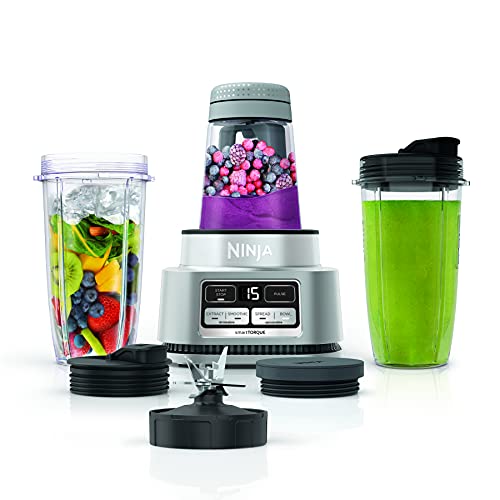
Ninja Foodi SS101 Smoothie Bowl Maker

Ninja SS151 TWISTi Blender DUO

Ninja Professional Plus BN701

TOPZEE Personal Smoothie Blender

Ninja Fit Compact Personal Blender
Why Smoothie Bowls Need More Than a Regular Blender
Smoothie bowls are thicker than drinkable smoothies because they use less liquid, and that thickness is exactly what a regular blender struggles with. You need enough power to keep the blades moving through dense frozen fruit, plus a way to push that fruit down into the blades. Without both, you’ll stop every few seconds to scrape the sides.
Peak watts don’t tell the whole story. A motor’s torque, or twisting force, is what keeps the blades spinning when the mixture resists. Ninja’s smartTORQUE motors are built to maintain speed under load, so the blades don’t bog down halfway through a thick bowl. That’s why a 1200-watt blender with a tamper can outperform a 1400-watt blender without one.
The blade design matters too. Stacked blades or hybrid edge blades create a vortex that pulls ingredients down toward the blades instead of letting them sit on top. A bowl maker or built-in tamper does the same job from above, pushing frozen fruit into the cutting zone. The Ninja Foodi SS101 combines a 1200-watt motor with a built-in tamper, which is why it handles thick bowls so well.
If you’re looking for a high powered blender for smoothies that can also handle frozen fruit for a bowl, the Ninja SS151 TWISTi is a strong choice. Its twist tamper locks into the lid, so you can press ingredients down without removing anything. For a powerful affordable blender for smoothies, the Ninja Foodi SS101 gives you the bowl-making power without the top-tier price.
The best blender for frozen smoothies is one that doesn’t make you work harder than the smoothie itself. Check for a tamper, a stacked blade design, and a motor with real torque under load. Those three details separate a blender that makes a spoonable bowl from one that only makes a thick drink.
 Home Juicing Starter KitMake fresh juice that tastes good, costs less and keeps safely: 40 recipes with exact amounts, a yield chart and a 4-week plan.40 juice, smoothie and shot recipesYield, storage and food-safety chartsCost, yield and shopping-list calculator (Excel)
How to Choose: Power, Bowl Maker, and Capacity
Three specs separate these blenders: power, bowl maker, and capacity. Power determines how thick you can go, a bowl maker determines how little you have to scrape, and capacity determines whether you’re making one bowl or enough for the family.
| Spec | What to look for | Why it matters |
|---|---|---|
| Power | 700W for thin smoothies; 1200W+ for thick bowls | More watts help, but torque and smartTORQUE keep blades spinning under load |
| Bowl maker | Built-in tamper or twist tamper | Pushes frozen fruit into the blades without stopping to scrape |
| Capacity | 24 oz single; 34 oz two bowls; 72 oz family | Match the pitcher to how many bowls you make at once |
Power: 700W is enough for a drinkable smoothie with fresh fruit and a little ice. But for a thick bowl packed with frozen fruit, you want 1200W or more. The Ninja Fit Compact Personal Blender has 700W, which is fine for thin smoothies but will struggle to make a spoonable bowl. The Ninja Foodi SS101 and Ninja Professional Plus both offer 1200W or more, and that’s the sweet spot for frozen bowls.
Bowl maker: a built-in tamper or twist tamper is the single most useful feature for thick bowls. It lets you press ingredients down while the blender runs, so the blades keep cutting instead of spinning in air. The Ninja Foodi SS101 has a built-in tamper, and the Ninja SS151 TWISTi has a twist tamper that locks into the lid. Both make thick bowls much easier.
Capacity: 24 oz is a single serving, which is perfect if you’re the only one eating a bowl. A 34 oz pitcher makes two bowls, and a 72 oz pitcher is family size. The Ninja Fit comes with two 16 oz cups, which are fine for thin smoothies but too small for a thick bowl with toppings. The Ninja Professional Plus has a 72 oz pitcher, so it’s the pick if you’re making bowls for several people.
Cleaning: dishwasher-safe cups and lids save time, and that matters when you’re making a bowl every morning. Exposed blades need careful handling, so look for a design where the blade assembly comes out or the cup is easy to rinse. The Ninja Foodi SS101 and Ninja SS151 TWISTi both have dishwasher-safe parts.
Budget: the best affordable blender for smoothies is the Ninja Fit at 700W, but it’s not built for thick bowls. If you want a budget blender that can still manage a thick bowl, the Topzee Personal Smoothie Blender at 1000W is a step up. The best low cost blender for smoothies that won’t frustrate you on frozen fruit is the Ninja Foodi SS101, which often sits in the mid-range.
If you’re still comparing across brands, our guide to the best ninja blender for smoothies lays out the full Ninja lineup. For a wider look at blenders that handle both shakes and smoothies, see best blender for milkshakes and smoothies.
Smoothie Bowl Recipes That Actually Work in These Blenders
Smoothie recipes for Ninja blender models follow one reliable pattern: pour liquid first, add greens, then frozen fruit, and blend for 30–45 seconds. How long to make a smoothie in a blender depends on thickness, but 45 seconds is usually enough with a tamper. Keep liquid between 1/4 and 1/2 cup for a bowl that holds its shape.
How much water is required to prepare Concord grape smoothie using a mini blender? With a 16 oz cup like the Ninja Fit, 1/2 cup water plus 1 cup frozen grapes and half a frozen banana works, but expect some ice crystals. Mini blenders simply cannot process very thick mixtures.
Energy Use and Noise: What to Expect
Energy-efficient blenders for smoothies are not about peak wattage. A 1200W Ninja uses about 0.02 kWh for a 45-second blend, which costs roughly 0.3 cents at average US electricity rates. The motor only draws full power for a few seconds when crushing the hardest frozen pieces.
All high-powered blenders are loud. Expect 80–90 dB, similar to a vacuum cleaner, while crushing frozen fruit. The Ninja Fit’s 700W motor is quieter than the 1200W+ models but still not silent. No blender in this list has a quiet mode.
If noise matters, blend in a closed kitchen or place the blender on a folded towel to reduce counter vibration. A sound enclosure helps but costs more than most of these machines. The energy-efficient blenders for smoothies guide covers quieter options if that’s your priority.
Which Blender Fits Your Kitchen and Routine
The best Ninja blender for smoothies depends on how you’ll use it, and most readers fall into one of five situations. Daily single-serve bowls in a small kitchen point to the Ninja Foodi SS101, which includes a 14 oz bowl with a built-in tamper and takes up about as much counter space as a kettle.
Couples who want two bowls at once, plus a pitcher for soups or sauces, get more from the Ninja SS151 TWISTi. Its 24 oz cup and 24 oz bowl handle double portions, and the twist-to-blend design means fewer buttons to wipe down.
For drinkable smoothies on the go, the Ninja Fit is the right tool. Two 16 oz cups with to-go lids fit a commute, and the 700-watt motor is plenty for thin blends, though it struggles with frozen fruit thick enough for a bowl.
Budget-conscious readers who still want a single-serve bowl should look at the Topzee 1000W. Its 24 oz cup is larger than the Ninja Fit’s, and the price stays low, but the motor is less proven for daily thick bowls.
Families who blend large batches of smoothies, dips, or frozen drinks will use the Ninja Professional Plus BN701. The 72 oz pitcher serves four to six people, but there’s no bowl maker, so you’d need to transfer thick blends to a bowl and stir by hand.
Portable USB blenders are not in this list. Their small motors and narrow cups can’t crush enough frozen fruit to make a spoonable bowl, and most aren’t flight-approved for carry-on liquids over 3.4 oz. If you need a travel blender for hotel smoothies, check the best portable blender for smoothies guide instead.
Before You Buy: A 5-Point Checklist
Run through these five checks before you order, and you’ll avoid the two most common regrets: a blender that’s too tall for the cabinet and a bowl that’s too small for your appetite.
For the best inexpensive blender for smoothies, the Topzee 1000W is the budget pick, but confirm the warranty details before buying from a marketplace seller. An affordable blender for quality smoothies doesn’t need 1400 watts; the 700-watt Ninja Fit handles drinkable blends well if you don’t need a bowl.