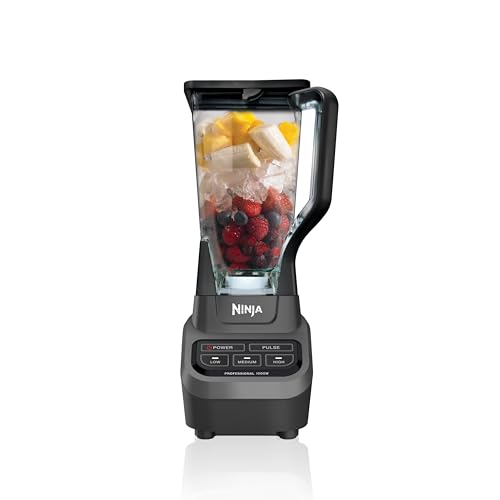
The Ninja Professional Blender BL610 is the best Ninja blender for smoothies for most people. Its 1000-watt motor and 72-oz pitcher blend frozen fruit and greens into a smooth drink, and the pitcher is dishwasher safe.
Say you make a 16-oz smoothie every morning with frozen berries, a handful of spinach, and almond milk. A 700-watt personal blender handles that in about 40 seconds, while a 1000-watt full-size model does the same job in 30. The right choice depends on how much you blend at once and whether you want to drink from the blending cup.
Ninja sells dozens of blenders, but only a few are worth considering for smoothies. The key differences are motor power, cup or pitcher size, and the presets that do the work for you. This guide compares the models that matter and explains the specs that actually affect your smoothie.
The Best Ninja Blenders for Smoothies, Ranked
#1Best for most people
Ninja Professional Blender BL610
Best for Family-size smoothie batches with a simple, powerful pitcher blender
The 1000-watt motor and Total Crushing blades make quick work of frozen fruit and leafy greens, and the 72-oz pitcher holds enough for several servings. It keeps things simple with no presets to fuss over, which suits anyone who just wants a reliable smoothie blender. The pitcher is dishwasher safe, so cleanup is straightforward after a big batch.
Power 1000 wattsCapacity 72-oz pitcher (64-oz max liquid)Presets NoneDishwasher safe Pitcher
Why it made the cut
1000 watts of power for crushing ice and frozen ingredients
72-oz pitcher for family-size smoothie batches
Dishwasher-safe pitcher for easy cleanup
Good to know
No presets or single-serve cups included
Large footprint on the counter
Skip it if Skip it if you want a compact blender with to-go cups for single servings.
Best for Households that want a full-size pitcher plus single-serve to-go cups
The 1100-watt motor handles both large batches in the 72-oz pitcher and personal smoothies in the two included 16-oz cups. A dedicated single-serve function and three manual speeds give you more control than the BL610. All removable parts are dishwasher safe, which makes cleanup flexible whether you used the pitcher or a cup.
Power 1100 wattsCapacity 72-oz pitcher + two 16-oz cupsPresets None (3 speeds, pulse, single-serve)Dishwasher safe All removable parts
Why it made the cut
1100 watts with Total Crushing blades
Includes two 16-oz to-go cups with spout lids
Three manual speeds plus pulse and single-serve function
Good to know
No preset programs like Auto-iQ
Slightly louder than smaller personal blenders
Skip it if Skip it if you only make single servings and want a smaller footprint.
Best for Smoothie drinkers who also want a food processor for chopping and dough
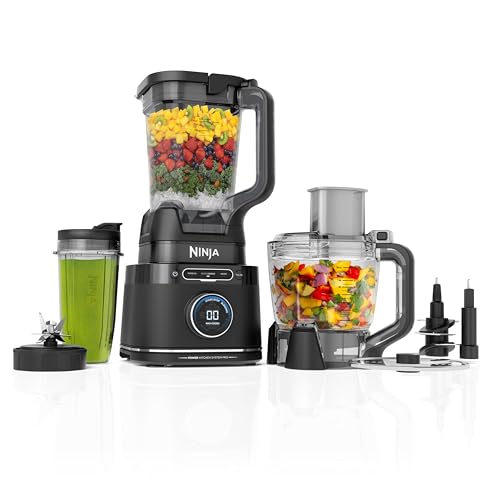
The 1500-watt motor powers both the 72-oz pitcher for smoothies and an 8-cup food processor bowl with chopping and dough blades. Two 16-oz Nutri Ninja cups with to-go lids cover single servings. Four functions — Blend, Mix, Crush, and Single-Serve — keep operation straightforward without a screen or app.
Power 1500 wattsCapacity 72-oz pitcher, 8-cup processor bowl, two 16-oz cupsPresets None (4 functions: Blend, Mix, Crush, Single-Serve)Dishwasher safe Not specified
Why it made the cut
1500-watt motor for tough ingredients
8-cup food processor bowl with chopping and dough blades
Includes two 16-oz cups with to-go lids
Good to know
Bulky footprint with multiple attachments
No preset programs for specific recipes
Skip it if Skip it if you already own a food processor and only need a smoothie blender.
Best for One-person smoothies with minimal counter space and quick cleanup
The 700-watt push-to-blend motor is strong enough for frozen fruit and ice, and you blend directly in the 16-oz cup. The compact base fits easily on a counter, and all parts are top-rack dishwasher safe. It’s a straightforward choice for daily single-serving smoothies without a large pitcher to wash.
Power 700 wattsCapacity Two 16-oz cupsPresets None (push-to-blend)Dishwasher safe All parts, top rack
Why it made the cut
700 watts for frozen ingredients
Two 16-oz to-go cups with spout lids
Compact design for small kitchens
Good to know
No pitcher for larger batches
Push-to-blend only, no speed settings
Skip it if Skip it if you regularly make smoothies for more than one person at a time.
Best for Hands-off smoothies with automatic adjustments and extra food prep tools
BlendSense technology automatically adjusts speed and time for each blend, which takes the guesswork out of smoothies. The 1800-peak-watt motor powers the 72-oz pitcher, a 24-oz single-serve cup, and an 8-cup processor bowl with slicing and shredding disc. Liquid detect alerts you when a blend needs more liquid, a helpful safety net for thick smoothies.
Power 1800 peak wattsCapacity 72-oz pitcher, 24-oz cup, 8-cup processor bowlPresets BlendSense automatic programsDishwasher safe Not specified
Why it made the cut
BlendSense automatic speed and time adjustment
1800 peak watts for tough ingredients
Includes 24-oz cup and 8-cup processor bowl with slicing/shredding disc
Good to know
Peak watts, not continuous operating watts
More parts to store and clean
Skip it if Skip it if you want a simple blender without a food processor attachment.
Peak Watts vs Operating Watts: What Actually Blends Your Smoothie
For a high powered blender for smoothies, the number that matters most is the operating wattage, not the big peak number on the box. Peak watts are a startup surge, while operating watts show the sustained power your smoothie gets.
Take the Ninja BN751: it’s stamped 1400 peak watts, but its operating wattage is 1200. That 1200 is what keeps spinning the stacked blades through frozen strawberries and kale once the initial burst is over. The BN401 is similar, 1100 peak and 1000 rated.
1200 W
Operating watts on the Ninja BN751
The BN751’s 1400-watt peak is a startup surge; 1200 is the sustained power that crushes frozen fruit.
Blade sharpness and design matter just as much. A dull stacked blade assembly will leave chewy bits even on a 1400-watt motor, while a sharp one turns the same load smooth. That’s why a powerful affordable blender for smoothies depends on more than the biggest number on the box.
As a rule of thumb, a 700-watt personal blender handles single servings of soft fruit and a few frozen chunks. For family batches, tough greens, and ice, look for 1000 operating watts or more in a full-size pitcher.
More watts, more noise
Higher wattage usually means a louder motor and a bit more energy use. An energy-efficient blender for smoothies with 1000 rated watts will still crush ice well, and it won’t wake the household.
If you only make one 16-ounce smoothie at a time, you don’t need 1400 peak watts. The best single serving smoothie blender for you may be a compact 700-watt model that blends and goes.
From JuicerAdvices · our own guideChoosing or using a juicer? Page 3 compares the types; page 15 fixes the common problems.Home Juicing Starter KitMake fresh juice that tastes good, costs less and keeps safely: 40 recipes with exact amounts, a yield chart and a 4-week plan.40 juice, smoothie and shot recipesYield, storage and food-safety chartsCost, yield and shopping-list calculator (Excel)$14.99$9.99Get it for $9.99See what's inside and watch the 2-minute video →18-page printable PDF + Excel calculator · instant download · 30-day refund
Cup vs Pitcher: Matching Capacity to Your Smoothie Volume
For one person, a personal cup is the smarter buy. A 16-ounce or 24-ounce to-go cup blends and goes, while a 72-ounce pitcher makes more than most of us drink at once.
A full-size 72-ounce pitcher holds up to 64 ounces of liquid, which is four big servings. That’s great for a family breakfast or a batch of frozen margaritas, but it’s overkill for one person and takes up more counter space.
Capacity
Typical use
Best for
16-oz cup
Single smoothie
One person, blend-and-go
24-oz cup
Large single or two small
One person, extra room
72-oz pitcher (64-oz max liquid)
Four 16-oz servings
Two or more people, batches
Cup and pitcher capacities against typical smoothie volumes
The simple rule: one person, personal cup. Two or more people, pitcher. A mini blender & blender smoothie setup like the Ninja Fit gives you two 16-ounce cups, perfect for a solo daily habit.
Some models include both, which is why they’re the best smoothie blenders for home for mixed households. The BL660 and BL770 pair a 72-ounce pitcher with two 24-ounce to-go cups, so you can make a batch and take one to work.
Measure before you buy
Check the pitcher’s max liquid line, not just the total volume. A 72-ounce pitcher typically blends only 64 ounces of liquid, and overfilling can leak or strain the motor.
If counter space is tight, a best single serving smoothie blender with a small footprint and one cup may be all you need. The BN401 base is only about six inches across.
Auto-iQ Presets for Greens, Frozen Fruit, and Bowls
Auto-iQ presets take the guesswork out of smoothie recipes for Ninja blender users. Each program runs a timed pattern of pulses, pauses, and speeds built for a specific texture, so you press one button and walk away.
The three presets you’ll use most are Smoothie, Frozen Drink, and Nutrient Extraction. Here’s what each one does best.
Smoothie pulses and blends in short bursts, then runs at higher speed to pull everything into a drinkable consistency. Use it for soft fruit, yogurt, and milk-based blends.
Frozen Drink runs longer and harder to crush ice and frozen fruit into a thick, slushy texture. Choose it for margaritas, frappes, or an extra-thick smoothie.
Nutrient Extraction (sometimes labeled Extract) spins at high speed for a longer stretch to break down fibrous greens, seeds, and skins. It’s the best blender for making vegetable smoothies with kale, spinach, celery, or cucumber.
If your Ninja has only two presets, like the Ninja Blender Pro+ BL660 with Smoothie and Crush, treat Crush as your Frozen Drink stand-in for ice-heavy recipes.
No presets? The Ninja Professional Blender BL610 runs on three manual speeds plus pulse, and that’s enough for daily smoothies. Start on low, ramp to high, and pulse a few times at the end to knock down any remaining chunks.
Quick preset guide
Greens and fibrous veggies = Nutrient Extraction. Frozen fruit and soft ingredients = Smoothie. Ice and frozen drinks = Frozen Drink. For smoothie bowls, run the Frozen Drink preset but stop it 10–15 seconds early for a thicker result.
Liquid Ratios for Spoon-Thick Bowls vs Drinkable Smoothies
Less liquid makes a thicker blend; more liquid makes it drinkable. For a standard drinkable smoothie, use about 1 part liquid to 1 part frozen fruit by volume. For a spoon-thick smoothie bowl, cut the liquid to 1 part liquid to 2 parts frozen fruit or even less.
Too little liquid is the fastest way to stall the blades. The motor keeps spinning, but the ingredients sit in a frozen clump against the pitcher wall, and the base can overheat. Add liquid a splash at a time, then pulse or use the tamper to push ingredients down toward the blades.
Personal cup blenders usually need a bit more liquid than full-size pitchers. The narrow cup gives ingredients less room to circulate, so a 1:1.2 or 1:1.5 ratio of liquid to frozen fruit often blends more cleanly.
Blend time stays short either way. Most Ninja smoothie programs finish in about 50 to 60 seconds, and manual blending rarely takes more than 90 seconds once the ratio is right.
Worked example
Say you want a drinkable berry smoothie. You add 1 cup of frozen mixed berries and 1 cup of almond milk, then run the Smoothie preset. For a bowl, you’d use the same 1 cup of berries but only ½ cup of almond milk, plus a scoop of yogurt for body, and stop the preset early.
Drinkable1 cup frozen fruit + 1 cup liquid
Spoon-thick bowl1 cup frozen fruit + ½ cup liquid
Don’t force a dry blend
If the blades spin but nothing moves, stop the blender. Add a tablespoon of liquid, pulse two or three times, and only then restart the full cycle. Running the motor against a stalled mass is what trips the thermal protection.
For the thickest bowls, look for a model with a tamper or a bowl maker attachment, like the Ninja Kitchen System Pro. A tamper lets you press frozen banana and berries into the blades without adding extra liquid, which keeps the texture dense enough to hold toppings. If you’re shopping specifically for that style, the best blender for smoothie bowls guide walks through the top Ninja options.
Cleaning the Hidden Gasket and Blade Assembly
A sour smell or a slow drip around the base means the rubber gasket under the blade is holding onto old smoothie. Dairy, protein powder, and fruit pulp collect in that groove, and a regular dishwasher cycle often misses it. The fix is simple: take the blade assembly apart and scrub the gasket by hand.
1
Rinse right after blending
Fill the pitcher or cup halfway with warm water, add a drop of dish soap, and run the blender for 30 seconds. This loosens residue before it dries.
2
Remove the blade assembly weekly
Unplug the base, then twist the blade assembly counterclockwise from the pitcher or cup. Check your model’s manual, but most Ninja assemblies separate the same way.
3
Scrub the gasket and groove
Peel the rubber gasket off the blade base. Wash it in warm, soapy water and use a small brush or toothpick to clear the groove where it sits. Rinse and let everything air dry completely.
4
Deep clean monthly
Soak the gasket in a 50/50 mix of warm water and white vinegar for 15 minutes, then scrub again. This removes any film that soap alone leaves behind.
If it still smells
A sour odor that survives scrubbing means the gasket has absorbed oils and should be replaced. Replacement gaskets are inexpensive and available from Ninja. Never run a cracked or warped gasket, because it will leak into the motor base.
Most Ninja pitchers and cups are top-rack dishwasher safe, but the gasket itself should be hand-washed at least weekly. Heat and detergent can stiffen the rubber over time. A quick rinse after every blend, a weekly disassembly, and a monthly vinegar soak keep even a budget pick like the Ninja Fit running clean for years.
What to Do Next: Pick Your Ninja and Start Blending
You do not need to overthink this. Decide how much smoothie you make, pick a model that matches, then follow a simple routine. Here is the five-step plan that gets you from scrolling to sipping.
Your Ninja smoothie checklist
Step 1: Decide between a personal cup and a 72-oz pitcher. Solo drinkers do fine with a 16-oz or 24-oz cup; families or batch preppers want the full pitcher.
Step 2: Choose wattage and presets for your style. For frozen fruit and greens, look for at least 1000 operating watts and a Smoothie or Extract preset. The Ninja Professional BL610 is the best Ninja blender for smoothies for most people.
Step 3: Start with the recommended liquid ratio and adjust. Use 1 cup liquid to 2 cups frozen ingredients for a drinkable smoothie, or cut the liquid to 1/2 cup for a spoon-thick bowl.
Step 4: Clean the gasket regularly. Rinse after every use, disassemble weekly, and deep clean monthly to prevent odors and leaks.
Step 5: If you already own a Ninja, check the gasket and blades before buying new. A dull blade or cracked gasket is a cheap fix, not a reason to replace the whole machine.
If budget is the main filter, the Ninja Fit is the best low cost blender for smoothies and handles a daily single serving without taking over the counter. For the best affordable blenders for smoothies in a full-size package, the Ninja Professional BL610 remains the value pick. Whichever you choose, the routine above keeps it blending like new.
More Questions, Answered
Does peak wattage or operating wattage matter more for crushing frozen fruit?
Operating wattage matters more because it’s the power the motor can sustain while blending. Peak wattage is a brief surge at startup, so a 1400-peak-watt motor that runs at 1200 watts will crush frozen fruit better than one that peaks at 1400 but drops to 900. Check the rated or operating watts on the spec sheet, not just the big number on the box.
How do I clean the hidden gasket in the blade assembly to stop a sour smell?
Twist the blade assembly out of the pitcher, then carefully pull the rubber gasket off the base. Wash the gasket and the groove it sits in with warm, soapy water, using a small brush to scrub away any residue. Let both dry fully before reassembling, and repeat this every few uses if you blend dairy or protein powder.
Which Auto-iQ preset should I use for kale and spinach smoothies?
Use the Smoothie preset for leafy greens, frozen fruit, and liquids. The Nutrient Extraction preset runs longer and at higher speed, which breaks down tougher greens like kale into a smoother drink. If your model has only a Smoothie preset, run it twice for very fibrous greens.
How much liquid do I need for a spoon-thick smoothie bowl versus a drinkable smoothie?
For a spoon-thick bowl, start with about 1/4 cup of liquid per 2 cups of frozen fruit and add more only if the blades stall. For a drinkable smoothie, use about 1/2 to 3/4 cup of liquid per 2 cups of frozen fruit. Add liquid gradually through the lid opening while blending to reach your preferred texture.
Are the to-go cups and pitcher lids dishwasher safe on the top rack?
Yes, the to-go cups, lids, and pitcher are dishwasher safe on the top rack. The blade assembly and gasket should be washed by hand to protect the sharp edges and rubber seal. Always place cups and lids away from the heating element, which can warp plastic.
Is a personal blender or full-size pitcher better for one person?
A personal blender with a 24-ounce cup is better for one person because you can blend and drink from the same container. A full-size 72-ounce pitcher means more cleanup and often a minimum fill line that forces larger batches. Choose a model with both if you sometimes make smoothies for others.
Before you go · a welcome giftGet the Home Juicing Starter Kit for $4.99Make fresh juice that tastes good, costs less and keeps safely: 40 recipes with exact amounts, a yield chart and a 4-week plan. Normally $14.99; your welcome price saves $10.00. We'll email your link right now.or skip the email and buy it now for $4.99 →One email with your link now. We never share your address.


 Home Juicing Starter KitMake fresh juice that tastes good, costs less and keeps safely: 40 recipes with exact amounts, a yield chart and a 4-week plan.40 juice, smoothie and shot recipesYield, storage and food-safety chartsCost, yield and shopping-list calculator (Excel)