
Juicer Brands
How Does the Susteas Juicer Machine Work With Its Extra-Wide Chute?
Discover what a Susteas juicer is, how its cold press works, and what to expect for juice yield, pulp removal, and cleaning.
JuicerAdvices answers the questions people really ask about what they drink: whether it is safe with a condition, a medicine or before a procedure, how much is too much, what is in it, and how to make juice at home that tastes good and keeps.

Three ways into the site. Pick the one that matches your question.
Drinks with a health condition, a medicine or before a procedure: the answer, the amount and when to ask your doctor.
All condition guidesCaffeine, sugar, sodium and acidity in the drinks you buy, from Red Bull to cranberry juice.
Browse every drinkJuice and smoothie recipes, how much produce to buy, and how long it keeps.
Storage & shelf lifeEach shelf collects the safety answers, nutrition numbers and how-tos for that drink.
 589 guides
Fresh, bottled and concentrate: how much is good for you
 646 guides
Caffeine, steeping and which teas suit your stomach
 191 guides
Blends that fill you up without the sugar spike
 122 guides
Caffeine, acidity and the drinks people swap it for
 114 guides
Caffeine and sugar per can, and safe limits
 251 guides
Kidneys, UTIs, medicines and how much to drink
 193 guides
Lemon water, acidity and everyday uses
 88 guides
Electrolytes, potassium and when it helps
 94 guides
Choosing, using and fixing your juicer
Newly written and recently updated, with the answer at the top and the numbers checked.
Discover what a Susteas juicer is, how its cold press works, and what to expect for juice yield, pulp removal, and cleaning.
Smoothies stored overnight are safe if refrigerated promptly and sealed; this guide covers how to keep them fresh,…
Discover the benefits of apple juice, its sugar content, vitamin C, and who should limit intake for health…
Banana juice can be safe for sick people in small amounts but watch sugar and acidity levels. Learn…
Is it safe to drink the juice out of sliced beets? Yes, up to 4 oz a day…
Coca-Cola produces over 200 brands globally, including sodas, waters, and juices, impacting your beverage options and choices.
Find out which low acid juices are safe for sensitive stomachs, how much to drink, and who should…
Our own printable guides, each with an Excel calculator: the same plain answers and real numbers as the articles, in a form you can print and write on.
 Home Juicing Starter Kit
Make fresh juice that tastes good, costs less and keeps safely: 40 recipes with exact amounts, a yield chart and a 4-week plan.
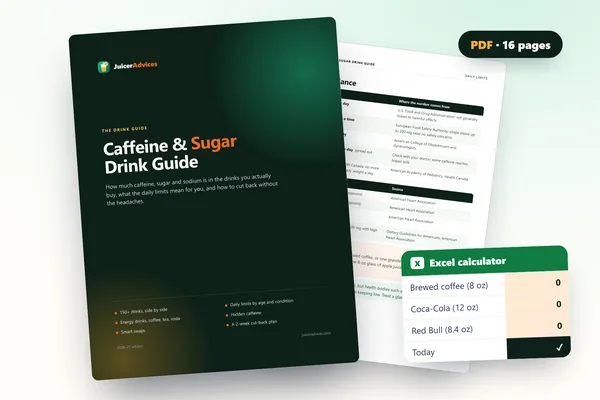 Caffeine & Sugar Drink Guide
Know exactly how much caffeine, sugar and sodium is in 150+ popular drinks, and set daily limits that fit you.
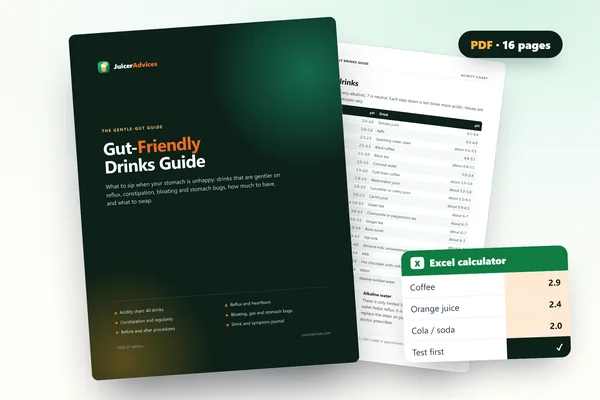 Gut-Friendly Drinks Guide
Drinks that are gentler on reflux, constipation and a sensitive stomach: what to sip, how much, and what to swap.
Most drink questions are really safety questions: can I have this with my condition, my medicine or my procedure, and how much? Every guide on JuicerAdvices opens with that answer, gives the amount with a unit, explains why, and says plainly when to ask your doctor or pharmacist.
The numbers come from public nutrition data and the labels themselves, and totals like caffeine or sugar per day are added up for you rather than estimated.
About JuicerAdvicesFor most healthy adults, about 4 to 8 ounces (half a cup to a cup) of 100% fruit juice a day is a sensible limit, because juice carries the fruit's sugar without most of its fiber. Vegetable juices are lower in sugar but can be high in sodium or potassium. If you have diabetes, kidney disease or take a blood thinner, ask your doctor what amount suits you.
The U.S. Food and Drug Administration says up to 400 mg a day is not generally linked to harmful effects in healthy adults; that is about four 8-ounce cups of brewed coffee. During pregnancy the usual advice is under 200 mg a day. Energy drinks range from about 80 mg to 300 mg a can, so check the label.
Kept cold in a full, airtight glass jar, juice from a centrifugal juicer is best drunk within about 24 hours and cold-pressed juice within about 48 to 72 hours. Freeze it for longer storage. Homemade juice is unpasteurized, so pregnant people, young children and anyone with a weakened immune system should drink it fresh or choose pasteurized juice.
No. JuicerAdvices explains drinks in plain language and points to public health sources, but it cannot know your health history. Every health guide says when to call your doctor or pharmacist, and you should check any change with them if you have a condition, take medicine, are pregnant or are preparing for a procedure.
No brand pays for a placement or a mention. As an Amazon Associate JuicerAdvices earns from qualifying purchases at no extra cost to you, and it sells its own printable guides; that is what keeps the articles free.
Start with the guides for your condition: each one gives the answer first, the amount that is usually fine, and the signs that mean you should call your doctor.


