The Nama J2 is the best cold press juicer for most people: a hands-free hopper, 50 RPM, and easy cleanup. If you want a budget pick, the YPONE 2-in-1 gives you a 5.8-inch chute and 400W for less.
The essentials
The Nama J2 is the best overall for hands-free juicing and easy cleanup.
For a budget pick, the YPONE 2-in-1 has a 5.8-inch chute and 400W motor.
The Ninja NeverClog is the easiest to clean and best for small kitchens.
A 50–55 RPM speed preserves more nutrients than faster juicers.
Check the warranty before you buy: the Nama J2 offers 15 years.
The most common mistake is buying a cold press juicer for the wrong reason: a huge feed chute you don’t need, or a hands-free hopper when you only juice once a week. That mistake costs you counter space, cleaning time, and money.
This guide compares the five juicers on the specs that actually matter: RPM, feed chute size, yield on leafy greens, cleaning time, and the warranty stated on the listing. Pick the one that fits how you juice, not the one with the biggest number.
The 5 Best Cold Press Juicers, Ranked
#1Best Overall
Nama J2 Cold Press Juicer
Best for Hands-free juicing with a self-feeding hopper and quick cleanup
The Nama J2 is the cold press juicer that fits into a busy morning because it does the work for you. Load the wide-mouth hopper with your whole recipe, walk away, and the self-feeding design cuts and juices the produce at a quiet 50 RPM. A 200W motor and quick-release parts mean you spend less time prepping and cleaning, and more time drinking your juice.
Juicer type Masticating (cold press)Speed (RPM) 50Feed chute Wide mouth hopper (whole recipe)Motor power 200 WCleaning Quick-release parts, cleaning brush included
Why it made the cut
Self-feeding hopper lets you load a whole recipe at once
Quiet 50 RPM operation with a 200W motor
Quick-release parts and included cleaning brush simplify cleanup
Good to know
Hopper is tall, so check clearance under cabinets
No separate pulp control filter
Skip it if Skip it if you want to control pulp texture or have very low cabinets.
Best for Choosing less pulp or lots of pulp with two interchangeable filters
The Ninja NeverClog earns its name with a high-torque motor that powers through fibrous produce like celery and leafy greens without clogging. Two interchangeable pulp filters give you real control over texture, and the anti-drip lever keeps your counter clean. It is compact enough to live under kitchen cabinets, which matters in a small kitchen.
Juicer type Masticating (cold press)Speed (RPM) —Feed chute Standard (pre-cutting needed)Motor power 150 WPulp control 2 interchangeable filters
Why it made the cut
Two pulp filters for less or lots of pulp
Anti-drip lever prevents spills when you pause
Compact design fits under cabinets
Good to know
Feed chute is not wide enough for whole apples
150W motor is less powerful than some competitors
Skip it if Skip it if you want to juice whole fruit without pre-cutting.
Best for A 5.8-inch chute and 400W power at a lower price
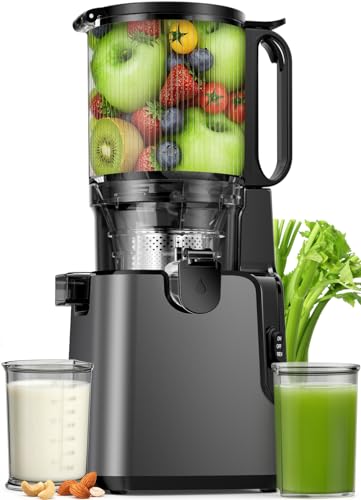
The YPONE 2-in-1 gives you a 5.8-inch feed chute that takes whole apples and oranges, so you skip the knife work. A 400W motor runs at 55 RPM, and the dual-layer mesh strainers are designed for a high juice yield. It also makes nut milk, which adds versatility if you want more than juice from one machine.
Juicer type Masticating (cold press), 2-in-1Speed (RPM) 55Feed chute 5.8 inchesMotor power 400 WExtras Makes nut milk, dual strainers
Why it made the cut
5.8-inch chute fits whole fruits and vegetables
400W motor with 55 RPM slow press
Makes nut milk and soy milk in addition to juice
Good to know
Larger footprint than compact models
Cleaning the dual strainers takes a little more effort
Skip it if Skip it if you have very limited counter space.
Best for A 5.3-inch chute and a filter that speeds cleanup by 50%
The EXREIZST cold press juicer is built around a 5.3-inch feed chute that takes whole produce, and a split-type filter screen that the brand says speeds cleaning by 50%. A 300W motor with a reverse function helps prevent clogs, and the hopper and screen are integrated so assembly takes seconds. It is a practical choice for daily use when you want minimal fuss.
Juicer type Masticating (cold press)Speed (RPM) —Feed chute 5.3 inchesMotor power 300 WFilter Split-type, metal-free
Why it made the cut
5.3-inch chute for whole fruits and vegetables
Split filter screen speeds cleaning
300W motor with reverse function
Good to know
No pulp control options
Plastic parts need careful handling
Skip it if Skip it if you want a metal filter or more power for tough greens.
Best for A blade-free design with lid-activated auto shutoff
The EanOruus cold press juicer prioritizes safety with a blade-free design and a lid-activated automatic shutoff that powers off the machine instantly if the lid opens. A 400W motor runs at 50 RPM, and the 5.8-inch chute takes whole apples and carrots. Three detachable parts and a cleaning brush make breakdown simple.
Juicer type Masticating (cold press)Speed (RPM) 50Feed chute 5.8 inchesMotor power 400 WSafety Blade-free, lid-activated shutoff
Why it made the cut
Lid-activated auto shutoff for safety
5.8-inch chute fits whole produce
400W motor at 50 RPM
Good to know
Fewer included accessories than some rivals
No pulp control filter
Skip it if Skip it if you prefer a juicer with a dedicated pulp container.
The best cold press juicer for you is the one that matches your produce and how much time you’ll actually spend cleaning it. The Nama J2 tops most best cold press juicer reviews because its hands-free hopper and 50 RPM auger handle leafy greens and soft fruit without a struggle. But the right pick depends on three specs: RPM, feed chute size, and cleaning time.
Spec
What it means
Good for
RPM
Lower RPM (40–80) means less heat and oxidation
Leafy greens, wheatgrass, longer-lasting juice
Feed chute
Wider chute (3.5 in+) means less pre-cutting
Whole apples, carrots, celery
Cleaning time
Fewer parts and no fine mesh strainer
Daily juicing without the dread
The three specs that separate these five juicers.
A cold press juicer is a masticating juicer that crushes produce slowly instead of shredding it at high speed. Less heat and air exposure means you keep more vitamins and enzymes, and the juice separates less. That matters if you’re juicing for a health goal, not just a quick glass.
Match the machine to your produce. Leafy greens like kale and spinach need a strong auger that grips and presses; the Nama J2 and Ninja NeverClog are built for that. Hard vegetables like beets and carrots need torque, not just a low RPM number. A machine that bogs down on a carrot will frustrate you by day three.
Skip the biggest chute if you juice soft fruit
A 5.8-inch chute like the YPONE’s saves time on whole apples, but if you mostly juice oranges or berries, a smaller chute is easier to clean and works just as well. Buy for your routine, not the marketing photo.
Check the warranty and build before you buy. A 10-year warranty on the motor, like the Nama J2 offers, signals the maker expects it to last. Look for metal or heavy-duty plastic augers, not thin plastic parts that flex under pressure.
You don’t need the largest feed chute. Most people over-buy on chute size and under-buy on cleaning convenience. A juicer that takes five minutes to wash after every use will sit on your counter unused, no matter how wide the chute is.
In short
Pick the juicer that matches your produce and your patience for cleanup. For most people, that’s the Nama J2; for budget-minded whole-fruit juicers, the YPONE 2-in-1.
From JuicerAdvices · our own guideChoosing or using a juicer? Page 3 compares the types; page 15 fixes the common problems.Home Juicing Starter KitMake fresh juice that tastes good, costs less and keeps safely: 40 recipes with exact amounts, a yield chart and a 4-week plan.40 juice, smoothie and shot recipesYield, storage and food-safety chartsCost, yield and shopping-list calculator (Excel)$14.99$9.99Get it for $9.99See what's inside and watch the 2-minute video →18-page printable PDF + Excel calculator · instant download · 30-day refund
Cold Press vs Centrifugal: What the RPM Really Means
A cold press juicer runs at 40 to 80 RPM; a centrifugal juicer spins at 10,000 RPM or more. That speed gap is why a slow juicer costs more, and why the juice looks and tastes different.
At 10,000 RPM, a centrifugal blade whips air into the juice. That oxidizes nutrients and creates foam. A cold press crushes the produce, so less oxygen gets in, and the juice stays fresher longer, often 48 to 72 hours in the fridge versus a few hours for centrifugal juice.
Myth
Cold press juicers are always better.
Fact
For leafy greens and wheatgrass, yes, a slow juicer extracts noticeably more juice. But if you mostly juice citrus or soft fruit and you want a glass in 30 seconds, a centrifugal juicer can be the better buy. It’s cheaper and faster, just noisier.
Heat is the other difference. Centrifugal friction warms the juice slightly, which can degrade vitamin C and enzymes. Cold press keeps the temperature stable, which is why it’s the standard choice for people juicing daily for a specific health goal.
When centrifugal makes sense
If you juice once or twice a week, mostly hard fruits and citrus, and you want to keep costs down, a centrifugal juicer is a reasonable pick. You’ll trade shelf life and green-juice yield for speed and a lower upfront cost.
Noise is a real daily factor. A centrifugal juicer sounds like a blender running; a cold press hums quietly enough to use before the rest of the house wakes up. If your morning routine is at 6 a.m., that matters.
In short
Lower RPM means less heat, less oxidation, and juice that lasts longer. Cold press wins for greens and daily use; centrifugal wins on speed and price for occasional juicing.
Feed Chute Size: Whole Fruit vs Pre-Cutting
A wider feed chute means less chopping, and the YPONE 2-in-1 has the widest here at 5.8 inches. That fits a whole apple or orange. The EanOruus and EXREIZST models also take whole fruit, so you’ll spend under a minute on prep. The Nama J2 and Ninja NeverClog, by contrast, need fruit cut into pieces first.
The trade-off shows up with leafy greens. A large chute lets you push through big handfuls of kale or spinach quickly, but the auger may not press them as thoroughly as a smaller, tighter feed tube. You’ll often see a little more juice in the pulp bin from wide-chute machines.
Whole-fruit chute (5.3 inches and up)
Fits whole apples, oranges, pears and beets
Cuts prep time to about 1 minute
Less knife work, less cleanup before juicing
Pre-cutting chute (under 3 inches)
Can leave slightly more juice in leafy-green pulp
Bulkier machines that take up more counter space
Hard produce like large carrots may still need halving
A smaller chute gives you more control. You feed produce in gradually, which helps the auger grip and extract more from greens, wheatgrass and soft herbs. If your mornings are mostly green juice rather than whole apples, the Nama J2’s narrower hopper is an advantage, not a flaw.
In short
Pick a 5-inch-plus chute if you juice mostly apples, oranges and beets and want to skip the cutting board. Pick a smaller chute if greens and maximum yield matter more than saving two minutes of prep.
Cleaning Time: The Spec Nobody Checks
Cleaning is the real daily cost of a cold press juicer, and the Nama J2 and Ninja NeverClog are the easiest here. Both have fewer parts than typical masticating juicers, and most pieces rinse clean in under two minutes. Budget models like the YPONE and EanOruus have more pieces to disassemble, so expect 5 to 15 minutes of cleanup.
Fast-clean checklist
Rinse the auger, screen and juice bowl within 5 minutes of juicing
Use the included brush on the mesh screen before pulp dries
Check which parts are dishwasher-safe; hand-wash the blade and screen if unsure
Wipe the base with a damp cloth; never submerge it
The 5-minute rule
A quick rinse right after juicing prevents pulp from drying onto the screen. Once it hardens, you’ll need to soak and scrub, which can double cleanup time.
Dishwasher-safe parts vary by model. The Nama J2 and Ninja NeverClog have top-rack-safe components, which makes them a better fit if you’d rather let the machine do the work. Cheaper juicers often require hand-washing, especially the fine mesh screen, which clogs if not rinsed promptly.
If you’re comparing by morning routine, count cleaning time, not just juicing time. A juicer that takes 3 minutes to juice but 12 minutes to scrub will sit unused by week two. The best cold press juicer reviews weigh this part heavily for a reason.
Which Cold Press Juicer Fits Your Health Goal
Pick your juicer by what you’ll actually drink most. Daily green juice calls for a strong auger and high yield on leafy greens, and the Nama J2 and Ninja NeverClog are the standouts here. Both press kale, spinach, and celery into a smooth, pulp-light juice without jamming.
If you’re juicing for the whole family or prepping a few days at once, capacity matters more. The YPONE 2-in-1 and EanOruus have wide chutes and large pitchers, so you can feed whole apples and handfuls of greens without stopping to chop.
For occasional juicing or a first machine, the EXREIZST is the sensible low-cost pick. It runs at 300W, uses BPA-free parts, and handles soft fruits and basic greens well enough for a few glasses a week.
Cold press juice fits a low-sugar routine when you build it around vegetables. Cucumber, celery, leafy greens, and a small piece of green apple keep the natural sugar down. Skip the fruit-heavy blends if you’re watching blood sugar, and pair the juice with a source of protein or fat to slow absorption.
Worked example
Say your goal is more greens without the sugar spike. You juice two stalks of celery, half a cucumber, a handful of spinach, and one green apple in the Nama J2. That’s roughly 12 g of natural sugar from the apple, far less than a 16 oz bottled green juice, which often runs 30 g or more.
DrinksHomemade green juice vs bottled
Sugarabout 12 g vs about 30 g
Low-sugar rule
Aim for at least two vegetables for every fruit. A thumb-sized piece of ginger adds warmth without sugar.
What to Do Next: Order, Unbox, Juice
Match the juicer to the produce you buy most. Everyday greens and a single glass? Go with the Nama J2 or Ninja NeverClog. Big weekend batches with whole apples and carrots? The YPONE or EanOruus earns its counter space.
1
Check the warranty and returns
Before you order, confirm the warranty length and the return window. Cold press juicers have moving parts, and a two-year warranty is common on the better models.
2
Wash every part on day one
Unbox the juicer, separate all removable parts, and wash them in warm soapy water. Dry them fully before reassembling.
3
Start with a forgiving recipe
Apple, carrot, and a small piece of ginger is the classic first juice. It’s sweet enough to enjoy and won’t stress the auger. Celery and cucumber is the gentler green option.
4
Clean right after you juice
Rinse the parts immediately, then wash with the included brush. Dried pulp is the only reason cleaning ever feels hard.
First batch size
Make only what you’ll drink within 24 hours. Cold press juice has no preservatives, so freshness drops fast.
If you’re still comparing, the top cold press juicers guide lays out the same picks with more detail on yield and noise.
More Questions, Answered
What is the difference between a cold press juicer and a regular juicer?
A cold press juicer crushes produce at 40 to 80 RPM, while a regular centrifugal juicer spins at 10,000 RPM or more. The slower speed means less heat and air get into the juice, so it tends to taste fresher and stay good in the fridge a little longer.
How long does cold press juice last in the fridge?
Most cold press juice stays fresh for 48 to 72 hours in an airtight glass jar. Fill the jar to the very top to limit air contact, and keep it below 40°F. Juice from leafy greens loses nutrients fastest, so drink those within a day.
Can a cold press juicer handle leafy greens like kale and spinach?
Yes, and that’s where cold press models really earn their price. The slow auger squeezes leaves against the screen instead of shredding them, so you get more juice from a handful of kale. Roll leaves into a tight ball and alternate with harder produce like apple or cucumber to keep the auger moving.
Is a cold press juicer worth the extra money?
It depends on what you juice most. The extra cost pays off if you make leafy green juices, want juice that lasts a couple of days, or drink juice daily and value a quieter machine. For occasional orange or apple juice, a good centrifugal model costs less and works fine.
How do I clean a cold press juicer without spending 20 minutes?
Rinse the parts right after juicing, before pulp dries, and most of the work is done. A soft brush gets into the screen’s tiny holes, and warm water with a drop of dish soap handles the rest. The Nama J2 and Ninja NeverClog have the fewest parts to wash, so cleanup takes about five minutes.
Can I make nut milk in a cold press juicer?
Yes, cold press juicers handle soaked almonds or cashews well. Run the nuts through with a little water, then strain the pulp through the juice screen for a smooth milk. The auger’s slow crush keeps the milk from heating up, which preserves the fresh nutty flavor.
What is the best cold press juicer for a small kitchen?
Look for a vertical model with a small footprint, like the Ninja NeverClog or the YPONE 2-in-1. Vertical cold press juicers take up about the same counter space as a kettle and store the cord underneath. If you have a low cabinet, check the height before buying, since some vertical models stand over 17 inches tall.
Before you go · a welcome giftGet the Home Juicing Starter Kit for $4.99Make fresh juice that tastes good, costs less and keeps safely: 40 recipes with exact amounts, a yield chart and a 4-week plan. Normally $14.99; your welcome price saves $10.00. We'll email your link right now.or skip the email and buy it now for $4.99 →One email with your link now. We never share your address.




 Home Juicing Starter KitMake fresh juice that tastes good, costs less and keeps safely: 40 recipes with exact amounts, a yield chart and a 4-week plan.40 juice, smoothie and shot recipesYield, storage and food-safety chartsCost, yield and shopping-list calculator (Excel)