Why Juice Costs Less Than Whole Fruit
On this page 5 sections
You see the price tag. A gallon of apple juice costs less than a bag of fresh apples. It doesn’t make sense at first glance. How can the processed product be cheaper than the raw ingredient? This isn’t a supermarket trick. It’s the raw reality of modern food economics.
Stop wondering and start understanding. The price gap is driven by cold, hard logistics, waste reduction, and massive scale. Your perception of value is about to shift. Let’s break down the exact mechanisms that make bottled juice cheaper than fresh fruit.

The Raw Economics: Production Cost Breakdown
Forget the produce aisle. Think like a manufacturer. The journey from orchard to carton involves several cost-slashing stages that fresh fruit can never achieve.
Bulk Processing is King
Juice companies don’t buy retail. They purchase fruit by the literal ton, often directly from growers or from the “ugly” fruit rejected by grocery stores. This bulk processing power crushes per-unit costs. They negotiate prices based on entire harvests, not per-pound retail markups. Seasonal gluts become their opportunity, locking in low prices for concentrate that can be stored and reconstituted year-round.
This is where economies of scale deliver their knockout punch. A single factory can process millions of pieces of fruit daily. The fixed costs of that plantequipment, labor, energyare spread over a colossal volume, making the cost per bottle negligible.
The Waste Elimination Game
Fresh fruit has a fatal flaw: it rots. Up to 40% of fresh produce is wasted somewhere in the supply chain. Juice processing annihilates this problem. Bruised, misshapen, or slightly overripe fruit? Perfect for juicing. The production yield from a ton of fruit is maximized because almost everything but the inedible parts is used.
The final product is then made shelf-stable through pasteurization. This heat treatment kills microbes, allowing juice to sit unrefrigerated for months. Compare that to the frantic race against time for fresh apples or oranges. The reduction in spoilage and logistics (no need for constant refrigeration in transit) saves a fortune, directly impacting the juice cost you see on the shelf.
For a concentrated, low-waste option you can use at home, many are turning to products like the Check price on Amazon. It embodies this principle of extended shelf life and convenience derived from processing.
Waste Elimination: How Processing Reduces Loss
Produce waste is the silent tax on fresh fruit. Juice processing is a masterclass in avoiding it.
- Pre-Consumer Waste: Supermarkets discard imperfect fruit. Juice manufacturers buy it at a steep discount.
- Post-Consumer Waste: You throw away cores, peels, and seeds. Industrial juicing extracts every last drop of value.
- Transport & Storage Loss: A pallet of juice boxes is far less fragile and perishable than a pallet of whole fruit. Fewer losses mean lower costs passed to you.
The economic reasons juice costs less than fruit are rooted here. Processing converts a perishable, variable product into a uniform, stable commodity. Stability is cheap. Perishability is expensive.
Scale & Efficiency: Manufacturing Advantages
Walk through the steps. See the efficiency.
- Receiving & Sorting: Fruit is washed and sorted at high speed by machines, not by hand.
- Extraction & Filtration: Juice is pressed out, and solids (pulp, skin, seeds) are removed. This fiber removal actually reduces shipping weight and volume, cutting freight costs.
- Concentration (Often): Water is evaporated off to create a syrup. This reduces volume by up to 80% for cheap storage and shipping. Water is added back later. You’re not paying to ship water across the globe.
- Pasteurization & Packaging: The juice is heated, then filled into sterile, lightweight containers on hyper-fast bottling lines.
Every step is optimized for speed and low marginal cost. This is juice production at its most efficient. Don’t overlook the role of frozen concentrate economics. By freezing concentrated juice, manufacturers can buy fruit at its cheapest seasonal price and produce juice for an entire year, smoothing out seasonal pricing fluctuations.
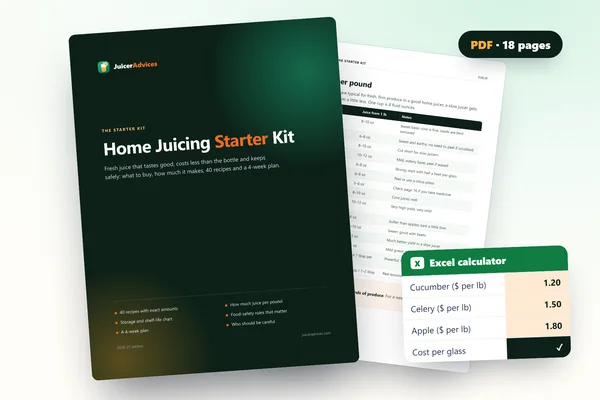 Home Juicing Starter KitMake fresh juice that tastes good, costs less and keeps safely: 40 recipes with exact amounts, a yield chart and a 4-week plan.40 juice, smoothie and shot recipesYield, storage and food-safety chartsCost, yield and shopping-list calculator (Excel)
Nutritional Trade-offs: What You’re Really Paying For
Here’s the critical pivot. Lower financial cost often comes with a nutritional trade-off. You must understand what you’re losing.
That fiber removal for efficiency? It’s a major nutritional loss. Fiber slows sugar absorption, feeds gut bacteria, and promotes satiety. A study on fruit juice and metabolic health highlights the differences in how our bodies process whole fruit versus juice. The sugar in juice hits your bloodstream fast, similar to a sugary soda.
Heat from pasteurization can also degrade some heat-sensitive vitamins and enzymes present in raw fruit. You’re paying for a shelf-stable, convenient product, not necessarily the peak nutritional profile of the original fruit. This is a core part of the juice vs whole fruit cost analysis. For a deeper dive into this specific comparison, consider the arguments for eating an apple versus drinking apple juice.
| What You Pay For in FRUIT | What You Pay For in JUICE |
|---|---|
| Fiber, full vitamin profile | Convenience, long shelf life |
| Perishability & waste risk | Stability & transportation efficiency |
| Retail handling & display | Bulk manufacturing & packaging |
| Natural form & sensory experience | Uniform taste & consistency |
This also explains private label vs branded juice pricing. The store-brand juice often uses the same concentrate as a national brand but skips the marketing costs. The base processed juice cost is identical.
Action Steps: Maximizing Value in Your Juice Choices
You have the facts. Now, act on them. Make informed decisions that align with your health and budget.
When to Buy Juice
- Prioritize Convenience & Shelf Life: Need a non-perishable pantry staple for recipes or quick calories? Juice works.
- Choose “Not From Concentrate”: It’s less processed than reconstituted concentrate, often tasting closer to the fruit.
- Explore Cold-Pressed Options: These are less processed but often more expensiveclosing the price gap with whole fruit due to lower yields and refrigeration needs.
When to Buy Whole Fruit
- Prioritize Nutrition & Satiety: You need the fiber, the full spectrum of nutrients, and to feel full. Always choose whole fruit.
- Buy In Season & Local: This is when the fruit price is lowest and the nutritional value is highest, countering the juice advantage.
- Freeze Your Own: Buy seasonal fruit on sale, chop it, and freeze it. Use it for smoothies where you keep the fiber.
Understand the different nutritional profiles to choose between options. For instance, the debate on apple juice versus orange juice benefits can guide a more specific choice.
The Smart Compromise
Consider a home juicer. You control the ingredients, can include vegetables, and drink it fresh to preserve nutrients. But you’ll face the true fruit price and deal with the pulp waste yourself. You’ll experience firsthand the juicing economics that favor scale.
The bottom line is clear. Juice is cheaper than fruit because industry transforms a perishable good into a stable, efficient commodity. You save money but often sacrifice fiber and some nutrients. Your move. Choose based on your need for convenience versus your commitment to whole-food nutrition. Know what you’re buying. Now you do.