You’re at a cookout, someone hands you a cup of something cold and peachy, and you catch the words “Crown Royal Peach.” If you’re gluten sensitive, your brain does a quick calculation: peach tea sounds harmless, but whisky is made from grain. The confusion is understandable because the name makes it sound like a bottled iced tea. It’s not.
Crown Royal Peach is a Canadian whisky flavored with peach liqueur and natural flavors. It contains no tea at all. The real question is whether the whisky base and the added flavorings introduce gluten into the final product. That answer is more nuanced than a simple yes or no, and it depends on how strict you need to be with your gluten threshold.
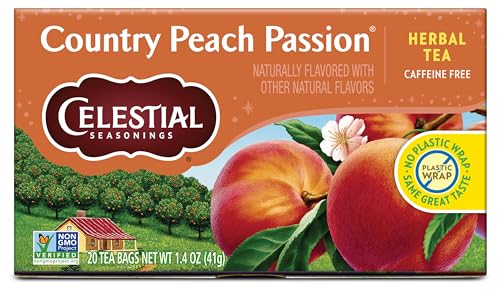
Celestial Seasonings
Celestial Seasonings Country Peach Passion Herbal Tea,…
- Herbal: This herbal tea is packed with delightful peach flavor and floral chamomile. Reminiscent of peaches just picked from the o…
- Thoughtful Sourcing: Most of our herbs, botanicals, teas, and fruits are purchased directly from farmers around the world
- Quality Ingredients: We blend our teas from the finest ingredients, with no artificial flavors or colors
This guide breaks down the distillation science, the labeling rules, and the practical risk for celiacs versus people with mild sensitivity. You’ll walk away knowing exactly where Crown Royal Peach stands and what to do if you want a peach-flavored drink without the whisky.
If you want the peach flavor without the alcohol, Celestial Seasonings Country Peach Passion Herbal Tea makes a solid caffeine-free alternative. It uses real peach and chamomile, so you get that orchard taste without any grain-based spirits involved.

What Crown Royal Peach Actually Is
Crown Royal Peach is a flavored whisky. The base spirit is Crown Royal’s blended Canadian whisky, which is made from corn, rye, barley, and wheat. The barley and wheat are the problem children here because both contain gluten proteins.
The whisky is distilled. Distillation heats the fermented grain mash until the alcohol vaporizes, then collects that vapor and condenses it back into liquid. Gluten proteins are large molecules. They don’t vaporize at the temperatures used in distillation. So the distilled spirit, in theory, contains no gluten proteins.
That’s the theory. The practice is a little messier because of what happens after distillation.
The Flavoring Problem
After distillation, Crown Royal Peach gets its peach flavor from a blend of natural and artificial flavorings. This is where the gluten risk sneaks in. Flavorings can use barley malt or wheat derivatives as carriers or stabilizers. The manufacturer doesn’t have to disclose those ingredients on the label because the FDA allows “natural flavors” to be a proprietary blend.
Crown Royal does not label any of its products as gluten-free. That’s a deliberate choice. The company states that while their whiskies are distilled from gluten-containing grains, they cannot guarantee that the final product is free of gluten proteins due to the flavoring process and potential cross-contamination during bottling.
For comparison, some other spirits producers test their finished products and label them gluten-free when the test comes back below 20 parts per million (ppm). Crown Royal has not done that. That absence of a label is not proof of gluten, but it does mean the company won’t stand behind a gluten-free claim.
What the Testing Data Says
Independent testing of distilled spirits has repeatedly shown that the distillation process removes gluten proteins to below detectable levels. A 2026 study published in the Journal of Analytical Toxicology tested 100 samples of distilled spirits, including whisky, and found no gluten peptides above the limit of detection.
But that study tested unflavored spirits. Flavored products are a different animal. The flavorings added after distillation can reintroduce gluten. The risk is low but not zero.
Gluten Free Yum’s analysis of Crown Royal products reached the same conclusion: the base whisky is likely safe for most celiacs, but the flavored versions carry an unquantified risk from the additives.
Who Should Avoid It
If you have celiac disease and you’re strictly adhering to a zero-tolerance protocol, Crown Royal Peach is not worth the gamble. The lack of a gluten-free label, combined with undisclosed flavoring ingredients, creates enough uncertainty to rule it out.
If you have non-celiac gluten sensitivity and you tolerate small amounts of gluten without symptoms, your risk is minimal. The distillation process removes the vast majority of gluten proteins. Trace amounts from flavorings, if any, would likely fall below the 20 ppm threshold that most experts consider safe.
If you’re newly diagnosed and still learning your tolerance levels, start with a different drink. There’s no reason to test your limits with a product that won’t give you a straight answer.
Comparing Your Peach Drink Options
| Drink | Gluten Risk | Contains Tea | Alcohol Content | Best For |
|---|---|---|---|---|
| Crown Royal Peach (neat or on ice) | Low but unverified; flavorings undisclosed | No | ~35% ABV | Whisky drinkers without celiac disease |
| Crown Royal Peach mixed with iced tea | Same as above; tea component is gluten-free | Yes (if you add it) | Depends on pour ratio | People who want the tea flavor alongside the whisky |
| Peach-flavored hard iced tea (e.g., Twisted Tea) | Made from malted barley; not distilled | Yes | ~5% ABV | People who want a canned, ready-to-drink option |
| Peach schnapps (e.g., DeKuyper) | Distilled from neutral grain; flavorings added | No | ~15-20% ABV | Mixers; sweeter profile |
| Celestial Seasonings Country Peach Passion (hot or iced) | Zero risk; no gluten ingredients | Yes (herbal) | 0% ABV | Anyone wanting peach flavor without alcohol or gluten |
The hard iced tea category deserves a special warning. Products like Twisted Tea are brewed from malted barley and are not distilled. They contain gluten and are not safe for celiacs. If you’re looking for a canned peach tea with a kick, check the label carefully. If it says “malt beverage,” put it back.
Common Misconception: “It’s Tea, So It’s Fine”
This is the biggest trap. People see “Peach Tea” on the bottle and assume the base is brewed tea. It’s not. The name refers to the flavor profile, not the ingredients. Crown Royal Peach tastes like peach tea because that’s the marketing angle, but the bottle contains whisky, sugar, and flavorings.
The related category of hard iced tea has the opposite problem. Those drinks actually do contain tea, but they’re often made with malted barley as the fermentable sugar source. That makes them gluten-containing even though they taste like tea.
Always read the label for the base ingredient, not the flavor description.
Common Misconception: “Distilled = 100% Gluten-Free”
Distillation removes gluten proteins from the final spirit. That’s scientifically sound. But the equation breaks down when you add post-distillation ingredients. Flavorings, colorings, and even the water used to dilute the whisky to bottling strength can introduce gluten.
Some producers test their final product and label it gluten-free. Crown Royal doesn’t. That distinction matters. A lack of label doesn’t mean gluten is present, but it means the company won’t guarantee its absence.
If you need certainty, choose a spirit that explicitly states its gluten-free status on the bottle. There are plenty of vodkas, tequilas, and even some whiskies that do.
Frequently Asked Questions
Is Crown Royal Peach safe for celiacs?
Most celiac advocacy groups advise against it because the product isn’t labeled gluten-free and the flavorings are undisclosed. The distillation process likely removes gluten from the base whisky, but the added flavorings create an unknown risk. If you’re strictly avoiding gluten, pick a different drink.
Does Crown Royal Peach contain actual tea?
No. The name is a flavor descriptor. The product is a peach-flavored Canadian whisky with no tea leaves or tea extract in the ingredients.
Can I drink Crown Royal Peach on a gluten-free diet?
If you have non-celiac gluten sensitivity and don’t react to trace amounts, you’ll probably be fine. If you have celiac disease, the lack of a gluten-free label is a red flag. The choice depends on your personal tolerance and risk tolerance.
What about Crown Royal Regal Apple or other flavors?
The same logic applies to all Crown Royal flavored whiskies. The base is the same distilled whisky, and the flavors are added post-distillation. None of them carry a gluten-free label.
Are there any gluten-free peach whiskies?
Yes. Some craft distilleries make peach-flavored whisky from 100% corn or sorghum and test their final product for gluten. Look for products that explicitly state “gluten-free” on the label. If you don’t see that label, assume the risk is unverified.
What to Do Next
- Check the label for the words “gluten-free.” If they’re not there, the producer won’t back the claim.
- Understand that distillation removes gluten from the base spirit, but flavorings can add it back.
- Treat flavored whiskies with more caution than unflavored ones.
- Avoid malt-based hard iced teas entirely if you’re celiac; they’re not distilled.
- For a zero-risk peach drink, brew a caffeine-free herbal tea like Celestial Seasonings Country Peach Passion and sweeten it to taste.
- If you’re mixing Crown Royal Peach at a party, ask the host for the bottle so you can read the label yourself.
- When in doubt, choose a spirit you know is safe. A drink isn’t worth a week of symptoms.