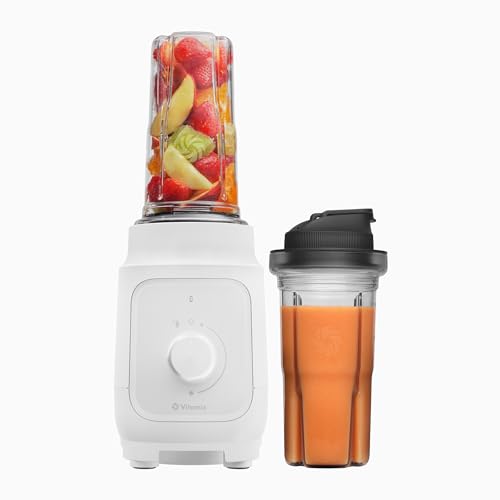
You’re looking at a new blender, maybe a Vitamix. The specs talk about watts and horsepower. What does it all mean for your kitchen counter and your energy bill? It’s not just a bigger number equals better. The relationship between blender wattage and real-world performance has nuances.
For a reliable workhorse that balances power and value, many home chefs start with the Vitamix Explorian E310. It delivers professional-grade results without the commercial-grade price tag, making it a fantastic entry point into high-performance blending.

Blender Wattage and Performance: The Real Story
Let’s clear the air. A blender’s wattage rating, often listed as motor power, indicates the electrical input the motor can handle. Think of it as the engine’s potential capacity. But the actual blender motor wattage used during operation varies. It depends entirely on what you’re blending and for how long.
Peak horsepower is a different, often marketing-heavy metric. It represents a motor’s maximum, instantaneous output under ideal lab conditions. Your daily smoothie won’t require that. More relevant is the continuous duty ratingthe power the motor can sustain without overheating. This is where a thermal protection system becomes critical, a feature in quality blenders that prevents burnout.
Why Amperage and Voltage Matter
Wattage is the product of voltage and amperage. In North America, standard household voltage is 120V. So, a 10-amp blender draws about 1200 watts. The amperage draw is crucial for your kitchen circuits. Most home circuits are 15 or 20 amps. Plugging a high-amp blender into a circuit already powering a microwave and toaster could trip a breaker.
International users, take note. If you’re moving a US-model Vitamix to a 220-240V country, you’ll need a heavy-duty transformer. The motor is built for a specific voltage. This is a key missing entity many guides overlook.
Vitamix Wattage by Model Series
Vitamix offers several series, each with different power consumption profiles. Heres a breakdown of typical specifications.
| Series/Model | Rated Motor Power | Peak Horsepower | Key Feature |
|---|---|---|---|
| Explorian (E310) | ~1380 watts | 2.0 HP | Entry-level high-performance |
| C-Series (5200) | ~1380 watts | 2.0+ HP | Classic container design |
| Ascent Series (A3500) | ~1400 watts | 2.2 HP | Smart features, programmability |
| Professional Series (750) | ~1440 watts | 2.2+ HP | Pre-programmed settings |
| Commercial (e.g., Vitamix legacy models) | 1500+ watts | 3.0+ HP | Built for continuous use |
So, what is the wattage of Vitamix 5200? It’s typically in that 1380-watt range, a benchmark for the brand. The differences between consumer models are often subtle, focusing more on controls and container styles than raw power leaps.
How Wattage Translates to Blending Results
Higher sustained wattage means the motor maintains speed under load. You notice this when crushing ice or pulverizing nuts. A weak motor bogs down. A powerful one powers through. This creates a smoother texture and more consistent emulsionsthink silky soups and nut butters.
But there’s a trade-off. More power can mean more noise and higher energy consumption. However, a powerful blender often completes tasks faster. A 30-second burst at 1400 watts might use less total energy than a 2-minute struggle at 700 watts. Efficiency matters.
Vitamix vs. The Competition: A Power Analysis
Vitamix wattage compared to Ninja and Blendtec is a common search. Heres the landscape.
- Blendtec: Often uses a different metric, focusing on peak horsepower (3.0+ HP is common). Their wattage ratings are similar, in the 1500-watt neighborhood. The blending jar design and blade speed create a different vortex, but both are titans in high-performance blender watts.
- Ninja: Offers a wide range. Their high-end systems may advertise similar peak horsepower, but the motor construction and thermal protection system can differ. They often provide excellent value but may not sustain peak power as long as a commercial-duty motor.
Does Vitamix use more electricity than other blenders? Not necessarily. A Vitamix and a similarly-rated Blendtec will have comparable kitchen appliance electricity draw for the same task. The real difference is in motor durability and the ability to handle years of heavy use, a hallmark of Vitamix commercial heritage.
Calculating Your Actual Electricity Cost
Let’s cover that missing entity. The cost to run your blender is minimal. Heres a simplified calculation.
- Find your blender’s wattage (e.g., 1400W).
- Convert to kilowatts (1.4 kW).
- Estimate daily use (e.g., 3 minutes = 0.05 hours).
- Multiply: 1.4 kW x 0.05 hrs = 0.07 kWh per day.
- Multiply by your electricity rate (e.g., $0.15/kWh).
That’s about one cent per day. Even heavy use rarely costs more than a few dollars a year. For a detailed method, the DOE offers an official source guide.
Smart Usage for Efficiency and Longevity
Your behavior impacts power use more than the specs sheet.
Practical Tips to Optimize Power
- Sequence Your Ingredients: Liquids first, then soft fruits, then hard or frozen items. This reduces initial motor strain.
- Use the Tamper: It’s not a cheat. It’s a tool to create vortexes efficiently, reducing blend time.
- Respect the Motor Sound: If it’s laboring, stop. Adjust the contents. Let the thermal protection system do its job, but don’t constantly trigger it.
- Clean Properly: A quick blend with soapy water uses less energy than disassembling and hand-washing numerous parts.
Consider your blending power requirements honestly. Making green smoothies daily? A personal blender might suffice. Creating nut flours, hot soups, and thick frozen treats? That’s where the sustained power of a high-performance blender earns its keep.
So, how many watts does a Vitamix use? Most home models sit comfortably between 1380 and 1500 watts. That number is a proxy for capability, not a direct meter of your utility bill. The investment isn’t in electricity; it’s in a tool that performs consistently, year after year. Choose based on the textures you want to create and the volume you need to handle. The power will be there.