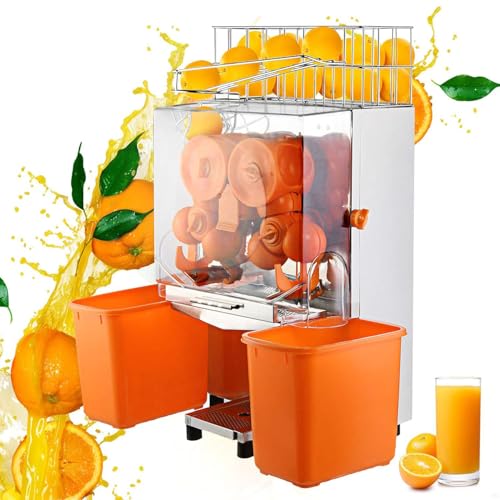
The VEVOR Commercial Orange Juicer Machine is the best commercial orange juicer machine for most buyers because it pairs a 120W motor with up to 20 oranges per minute, a 55-80 mm feed chute, and a pull-out filter box that makes cleanup simpler between rushes.
Key takeaways
Choose a machine by oranges per minute, not by the loudest claim on the listing.
A 55-80 mm chute fits most common orange sizes and reduces hand-feeding.
Pull-out filter boxes and removable parts save time at closing.
A protective cover and switch guard matter in busy, wet prep areas.
If your service is small, a slower juicer can still make sense if cleanup is simpler.
Say your café expects a lunch rush, and you need to turn a crate of oranges into juice without slowing the line. A machine that feeds 20 oranges per minute and accepts 55-80 mm fruit is built for that kind of service.
If you’re choosing for a restaurant, juice bar, or hotel breakfast station, the real differences are speed, chute size, cleanup time, and how much pulp control you get. Color and marketing copy matter far less than those four things.
Commercial Orange Juicers Worth Comparing
#1Best overall
VEVOR Commercial Orange Juicer
Best for Most cafés and juice counters
This one fits the busiest everyday citrus jobs because it combines a 120W motor with output of up to 20 oranges per minute. The 55-80 mm feed chute handles common orange sizes, and the pull-out filter box makes cleanup less of a slowdown between rushes. It’s a practical pick when you want speed without a complicated setup.
Motor 120WOutput up to 20 oranges per minuteFeed chute 55-80 mmMaterials food-grade SUS304 stainless steel and high-quality PCSafety feature pressure sensor in the transparent protective cover
Why it made the cut
Up to 20 oranges per minute
Pull-out filter box helps with cleaning
Food-grade stainless steel and PC cover
Good to know
Only one waste setup is listed
Large commercial unit takes counter space
Skip it if Skip it if your workflow needs a slower press style instead of an automatic extractor.
TECSPACE stands out for the way it organizes the mess: it has two peel collection buckets and a drip tray, so juice and waste have separate places to go. The 120W machine is built for up to 20 oranges per minute, which is enough for steady service. A removable transparent PC cover also helps when it’s time to clean.
Motor 120WOutput 20 oranges per minuteFeed chute 40-80 mm orangesWaste handling 2 peel collection buckets and 1 drip trayMaterial 304 stainless steel
Why it made the cut
Two peel collection buckets
Drip tray included
Protective cover can be removed for cleaning
Good to know
No pull-out filter box listed
No detailed juice chute size listed in the data
Skip it if Skip it if you want the simplest filter-cleaning setup and the data sheet matters more than bucket storage.
CMICE is the speed play here, with output listed at 22-30 oranges per minute. The pull-out filter cartridge is the feature that helps most when you’re trying to keep juice moving and cleanup simple at the same time. A food-grade stainless steel housing and acrylic cover keep the build straightforward for a service counter.
Motor 120WOutput 22-30 oranges per minuteVoltage 110VFilter pull-out filter cartridgeMaterials food-grade stainless steel housing and acrylic
Why it made the cut
Fastest output listed in this group
Pull-out filter cartridge
Protected switch and cover
Good to know
No feed chute size listed
More throughput than many small counters need
Skip it if Skip it if your staff needs a spec sheet with chute size before buying.
This model matches the E2 style with the same 22-30 oranges per minute output, so it suits counters that need volume. The upgraded pull-out filter cartridge is the main cleanup advantage, because it helps collect juice and residue more neatly. A top storage basket keeps fruit close at hand during rush periods.
Motor 120WOutput 22-30 oranges per minuteVoltage 110VFilter pull-out filter cartridgeMaterials food-grade stainless steel housing and acrylic
Why it made the cut
High output for busy service
Pull-out filter cartridge for easier cleaning
Top storage basket helps with loading
Good to know
Specs overlap heavily with the E2
No chute size listed
Skip it if Skip it if you need a model that clearly differentiates itself beyond the basic high-output format.
Best for Menus that use oranges, lemons, and pomegranates
This VEVOR model is the better fit when your citrus program is less about sheer speed and more about a broader fruit menu. It uses four rotating shaft assemblies and a built-in filter plate, so juice is separated from pulp during pressing. The adjustable fitting knob gives you more flexibility with different fruit sizes.
Motor 100WProcessing 132-176 lbs/60-80 kg per hourJuicing method four rotating shaft assembliesFruit sizes adjustable fitting knobUse cases restaurants, beverage shops, supermarkets, amusement parks,
Why it made the cut
Works with lemons, oranges, and pomegranates
Built-in filter plate
Adjustable fitting knob
Good to know
Slower, more manual process than the fast extractors
Requires fruits to be washed, peeled, pitted, and cut
Skip it if Skip it if your main goal is the fastest orange-only service line.
A commercial orange juicer machine, commercial orange squeezer, orange juice machine commercial, or commercial orange juice squeezer machine should match your line speed, your oranges, and your cleanup time. Automatic centrifugal-style citrus machines usually move faster for bar service, while slower pressing models fit steadier prep where you care more about consistency than sheer output.
Spec
What to check
Why it matters
Juicer type
Automatic centrifugal-style or slower pressing
Faster service is useful only if the rest of the setup keeps up
Output per minute
Use the stated rate with the feed chute and cleanup time in mind
A high number on paper can shrink fast if the machine slows at the counter
Feed chute
A stated range that matches the oranges you buy, often 40-80 mm
Less sorting, less rework, and fewer jams from fruit that does not fit
Pulp and peel handling
Pulp control, peel buckets, and drip management
These details decide whether the counter stays tidy during a rush
Cleaning features
Pull-out filter boxes and detachable parts
Fast cleanup saves labor at close and between shifts
In short
Pick the machine that fits the fruit, the counter, and the staff who will clean it. A faster juicer with a narrow chute or awkward washdown can slow service more than a modest model with easier handling.
Check the listing for what it actually says. If a color option is the main selling point and the page is vague on chute size, pulp control, or removable parts, you do not have enough information to buy well.
Use The Chute As Your First Filter
Buy to the oranges you already order, not to a label claim. If your produce comes in mixed sizes, a wider stated range can cut sorting and keep the line moving.
A simple test helps. If the machine can process fruit quickly but leaves you fighting peel bins, dripping spouts, or a hard-to-remove filter box, the real service pace drops fast. For buyers comparing citrus-focused models with other commercial options, commercial juicers is a useful next step.
From JuicerAdvices · our own guideChoosing or using a juicer? Page 3 compares the types; page 15 fixes the common problems.Home Juicing Starter KitMake fresh juice that tastes good, costs less and keeps safely: 40 recipes with exact amounts, a yield chart and a 4-week plan.40 juice, smoothie and shot recipesYield, storage and food-safety chartsCost, yield and shopping-list calculator (Excel)$14.99$9.99Get it for $9.99See what's inside and watch the 2-minute video →18-page printable PDF + Excel calculator · instant download · 30-day refund
Which Machine Fits Your Service Style
For a fresh orange juice machine commercial setup, a commercial orange extractor, or a commercial juicer machine for restaurant service, the right pick depends on how fast you pour and how much room you have at the station. None of these are small countertop gadgets; they belong in food-service spaces with room for peel buckets and a juice container.
Good for
VEVOR Commercial Orange Juicer Machine if you want the best overall mix of speed and easier cleanup on a busy counter.
TECSPACE Commercial Juicer Machine if you want a stainless-steel build, 40-80 mm orange capacity, and twin peel buckets.
CMICE Commercial Juicer Machine E2 or E2x if you want a 120W machine with a pull-out filter box and a higher stated output range.
The slower VEVOR pressing model if you care more about pressing style and broader citrus versatility than top speed.
Not for
VEVOR still needs counter space and routine cleaning between rushes.
TECSPACE is built for service, so it is more machine than a casual prep tool.
CMICE E2 and E2x are better fits where volume matters, not tiny prep corners.
The slower pressing VEVOR will not match the fastest models for peak rush speed.
Best fit for busy counters
VEVOR Commercial Orange Juicer Machine
Choose the VEVOR Commercial Orange Juicer Machine if you want one machine that keeps pace with steady service and does not turn cleanup into a second shift.
A café doing morning orange juice and a restaurant building a brunch line do not need the same setup. The café may care more about easy wipe-downs, while the restaurant may want higher stated output and a larger peel setup.
TECSPACE makes sense when stainless steel and a 40-80 mm fruit range matter more than a compact footprint. CMICE E2 and E2x suit shops that want a 120W machine with a pull-out filter box and stronger stated output for repeated orders. The slower VEVOR model is the one to look at if your menu leans toward mixed citrus and you value pressing style over top speed.
If you want a broader look at restaurant-ready machines beyond orange-only service, commercial juicers is the closest follow-up. Buyers who care more about lower-volume cold pressing can also compare commercial cold press juicer options.
Cleaning And Safety Matter More Than Marketing
A commercial orange juicer machine, or commercial orange juice machine, was first created for busy food-service counters to make high-volume citrus service faster and more consistent than hand squeezing. The origin story matters less than the current listing when you need fast cleanup and safe shutdown in a wet prep area.
Food-grade stainless steel and detachable parts help with routine sanitation when juice and peel residue build up during service. A transparent protective cover and a pressure sensor can stop operation when the cover is removed, which helps when staff are learning the machine or cleanup has to happen fast. A switch cover and waterproof protection on the listing are practical in a wet prep area, where drips and splashes are part of the job.
Myth
The oldest commercial orange machine is the safest buy.
Fact
Modern listings matter more than origin stories because removable parts, cover interlocks, and sealed controls affect cleaning and shutdown every shift.
What To Look For
Food-grade stainless steel on the parts that touch juice and peel
Detachable parts you can remove for washing
A transparent protective cover with a pressure sensor
A switch cover and waterproof protection for wet counters
Power Down Before You Clean
Unplug the machine before cleaning or clearing a jam, and never reach near moving augers, blades, or other moving parts.
When To Get Help
Get medical help now if a cut from cleaning or clearing a jam won’t stop bleeding, or if a broken part ends up in the juice and someone may have swallowed it.
A deep cut, crushed finger, or swelling after a jam
A shard of plastic, metal, or glass in the juice
Best Pick By Budget And Volume
In short
The best commercial orange juicer machine for most buyers is the VEVOR 120W automatic model, even if your search landed on commerical orange juicer. Its 120W motor, 55-80 mm feed range, and pull-out filter box make it the broadest fit for steady service and simpler cleanup. TECSPACE makes sense if you want a stainless build and dual waste bins for a steadier counter rhythm. CMICE E2x is the stronger fit if you want the higher stated output figure and a pull-out filter cartridge. The slow-press VEVOR belongs on menus that lean on citrus variety and prefer pressing-style extraction over raw speed. Budget choice depends on volume, not just the sticker price; a cheaper machine that slows service
Good For Busy Counters
VEVOR, TECSPACE, and CMICE all make more sense when orange juice is part of the daily rush and cleanup has to stay quick.
A stainless build, dual waste bins, or a pull-out filter can save time when staff are moving fast.
Not For Light Use
A low-price machine can cost more if it slows each batch and ties up labor during peak hours.
A higher-output model is harder to justify when you only press a few oranges at a time.
What To Do Before You Order
Before you order an orange commercial juicer, a commercial orange squeezer, or the orange juice machine commercial sempa listing you saw, measure the counter and cabinet space first, because these machines need room for a juice container and a waste bucket.
1
Measure the setup space
Check the footprint on the spec sheet, then compare it with your open counter and the height under the cabinets. Leave extra room for lifting the container out without bumping the backsplash.
2
Match the chute to your oranges
Compare the chute range with the fruit size you buy most often, especially if your deliveries mix small and large oranges. A wider opening helps only when your produce is really variable.
3
Size the speed to your hourly volume
Choose between faster automatic feeding and slower pressing based on how many drinks you pour in an hour, not the biggest number in the title. A smaller café with steady rushes may do fine with slower output.
4
Check the cleanup parts
Look for detachable parts, a pull-out filter, and a waste bucket if closing cleanup is part of your day. Those details cut down on scraping pulp out of tight corners.
5
Skip vague listings
If the listing leaves out the chute range, parts layout, or cleanup details, skip it and buy the model with the clearest specs. Clear listings are easier to compare and usually easier to live with.
Before You Click Buy
Counter width and cabinet height measured
Room for the juice container and waste bucket
Chute range that fits your oranges
Detachable parts and pull-out filter listed
Spec sheet gives clear speed and cleanup details
If you’re still comparing higher-capacity models, heavy duty juicers is the next page to open.
Frequently Asked Questions
What is a commercial orange juicer machine?
A commercial orange juicer machine is a countertop machine that squeezes oranges quickly for café, restaurant, or juice-bar service. Most models are built to keep pace with repeated orders, with removable parts that make batch work and cleanup faster than a hand press.
What features should I look for in a commercial orange juicer?
Look for output speed, fruit size range, and how easy the machine is to clean between rushes. A wide feed opening, a removable pulp bin or filter, and stainless steel parts usually matter more than a long spec sheet.
How much output do I need for a busy juice bar?
For a busy juice bar, size the machine to your peak rush, not your slow hour. If orange juice is a core menu item, choose a unit that can keep pouring without long pauses for refilling, clearing pulp, or washing parts.
What orange size fits most commercial orange juicers?
Most commercial machines are made for medium oranges, and the exact fit depends on the feed chute or squeezing cup. The VEVOR example lists a 55-80 mm range, so very small or oversized fruit may need sorting before service.
Are stainless steel commercial orange juicers easier to clean?
Yes, stainless steel is usually easier to wipe down because it has a smooth surface and resists corrosion better than many coated finishes. Cleaning still depends on whether the basket, filter, and contact parts come apart without tools, so removable parts matter just as much.
What is the difference between an automatic citrus juicer and a slow pressing model?
An automatic citrus juicer is built for speed and repeat pours, while a slow pressing model works more gradually and often gives you less foam and a drier pulp. The tradeoff is pace: slow pressing can be gentler on texture, but it can bottleneck a rush.
Where is the first commercial orange juicer machine from?
There isn’t one single agreed origin for the first commercial orange juicer machine. Early commercial citrus juicing equipment grew out of restaurant and soda-fountain needs in the late 1800s and early 1900s, so the history is spread across several designs rather than one famous machine.
Before you go · a welcome giftGet the Home Juicing Starter Kit for $4.99Make fresh juice that tastes good, costs less and keeps safely: 40 recipes with exact amounts, a yield chart and a 4-week plan. Normally $14.99; your welcome price saves $10.00. We'll email your link right now.or skip the email and buy it now for $4.99 →One email with your link now. We never share your address.




 Home Juicing Starter KitMake fresh juice that tastes good, costs less and keeps safely: 40 recipes with exact amounts, a yield chart and a 4-week plan.40 juice, smoothie and shot recipesYield, storage and food-safety chartsCost, yield and shopping-list calculator (Excel)