Best Blender for Frozen Fruit Smoothies: Top 5 Powerful Picks
On this page 8 sections
- Frozen Fruit Blenders Compared
- Best Blenders for Frozen Fruit Smoothies
- What to Look for in a Blender for Frozen Fruit
- Portable Blenders for Frozen Fruit: Do They Work?
- How Much Power Do You Need for Frozen Fruit?
- Single-Serve vs. Pitcher Blenders: Which Is Right for You?
- Cleaning and Maintenance for Frozen Fruit Blenders
- Frequently Asked Questions
Frozen Fruit Blenders Compared
| Rank | Model | Best for | Power | Capacity | Best for | Price |
|---|---|---|---|---|---|---|
| 1 | Ninja Fit Compact Personal BlenderBest for most people | Daily single-serve smoothies with frozen fruit in a compact, easy-clean package. | 700 watts | 2 x 16-oz cups | Most people | Check price |
| 2 | Ninja Professional Plus BlenderBest family pitcher | Large batches of frozen fruit smoothies with hands-off preset programs. | 1400 peak watts | 72-oz pitcher | Family batches | Check price |
| 3 | Ninja Nutri-Plus Personal BlenderBest larger cups | Single-serve smoothies with more capacity and extra cups for meal prep. | 900 peak watts | 3 x 20-oz cups | Larger single-serve | Check price |
| 4 | Ninja Professional BlenderBest value pitcher | Large batches on a budget, with enough power for frozen fruit and ice. | 1000 watts | 72-oz pitcher | Value pitcher | Check price |
| 5 | TOPZEE Personal Smoothie BlenderBudget single-serve | Occasional smoothie makers who want a simple, affordable single-serve blender. | 1000 watts (max 1200W) | 24-oz cup | Budget single-serve | Check price |
Frozen fruit turns a smoothie thick and frosty, but only if your blender can break it down without leaving icy chunks. The right machine depends on how much you make at once and whether you want to blend and go.
We compared five blenders on power, capacity, and cleanup. Here’s what matters when you’re blending frozen strawberries, mango, or banana every morning.
Best Blenders for Frozen Fruit Smoothies

Ninja Fit Compact Personal Blender

Ninja Professional Plus Blender

Ninja Nutri-Plus Personal Blender
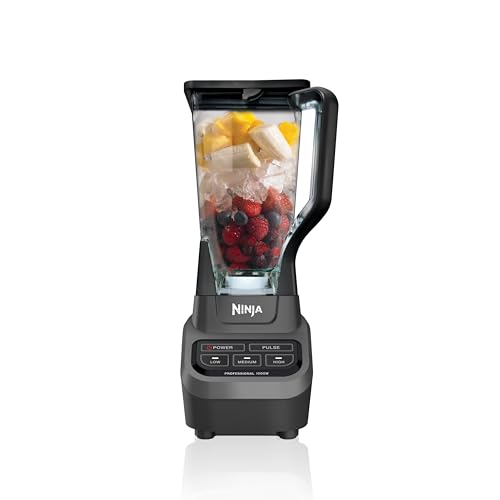
Ninja Professional Blender

TOPZEE Personal Smoothie Blender
What to Look for in a Blender for Frozen Fruit
The best blender for frozen smoothies needs at least 700 watts, a multi-prong blade, and a cup or pitcher that fits your batch size. For most people, that means the Ninja Fit Compact Personal Blender: 700 watts, 16-oz cups, and dishwasher-safe parts. If you’re blending for a family, step up to the Ninja Professional Plus Blender with its 72-oz pitcher and 1400-watt motor.
Power matters first. Frozen fruit is dense, and a weak motor leaves chunky bits or stalls. 700 watts is the floor for single servings; 1000 watts or more handles larger batches and tougher ice without straining. The Ninja Professional Blender’s 1000-watt motor sits right at that threshold, while the Professional Plus gives you extra headroom.
Capacity shapes every smoothie. A 16-oz cup is perfect for one person and blends right where you drink it. A 72-oz pitcher covers a family breakfast or meal prep for a few days. The Ninja Nutri-Plus Personal Blender splits the difference with three 20-oz cups, so two people can have different smoothies at once.
| Spec | What to look for | Why it matters |
|---|---|---|
| Power | 700 W minimum; 1000+ W for big batches | Crushes frozen fruit smoothly without stalling |
| Capacity | 16 oz for one; 72 oz for a family | Matches your typical batch size |
| Blade design | Stacked or multi-prong blades | Pulls frozen chunks down into the blade |
| Cleaning | Dishwasher-safe cups and lids | Saves time on daily smoothies |
| Portability | Blends in the cup you drink from | Fewer dishes and easy on-the-go |
Blade design is the quiet secret. Stacked or multi-prong blades create a vortex that pulls frozen fruit down into the blade instead of letting it bounce on top. That’s why all five picks above use some version of this design, and why a cheap blender with a single flat blade disappoints on the first frozen strawberry.
Cleanup decides whether you’ll actually use the blender daily. Dishwasher-safe cups, lids, and blades mean you rinse and go. The Ninja Fit’s cups and lids are dishwasher-safe, and its blades rinse clean under running water in seconds.
 Home Juicing Starter KitMake fresh juice that tastes good, costs less and keeps safely: 40 recipes with exact amounts, a yield chart and a 4-week plan.40 juice, smoothie and shot recipesYield, storage and food-safety chartsCost, yield and shopping-list calculator (Excel)
Portable Blenders for Frozen Fruit: Do They Work?
Yes, portable blenders are good with frozen fruit when they have at least 700 watts and you use small pieces plus liquid. The best portable blender for frozen fruit is the Ninja Fit Compact Personal Blender: it crushes frozen berries and banana in a 16-oz cup and costs less than most full-size blenders. Just don’t expect it to pulverize a full tray of ice cubes like a 1400-watt pitcher blender would.
The trick is portion control. Frozen fruit should be cut into roughly 1-inch chunks, and you need about 1/2 cup of liquid (milk, yogurt, or juice) for every cup of frozen fruit. Too little liquid makes the blades spin in an air pocket; too much dilutes the smoothie. The Ninja Nutri-Plus Personal Blender’s 900-watt motor gives you a bit more power for thicker blends.
Single-serve cups are the real advantage. You blend and drink from the same cup, so there’s one less dish and no pour-over mess. The TOPZEE Personal Smoothie Blender works the same way, and its compact size fits a gym bag or office drawer.
If you want more options, see the top portable blenders for side-by-side picks. For a broader look at ice-crushing machines, the best blender for frozen drinks guide compares full-size models too.
How Much Power Do You Need for Frozen Fruit?
You need at least 700 watts to blend frozen fruit into a smooth, drinkable texture. Lower wattage leaves icy chunks and forces the motor to strain, which can shorten its life.
If you blend mostly soft fruit with a few frozen berries, 700 to 900 watts is enough. For dense ingredients like frozen bananas, mango chunks, or ice, 1000 watts or more gives smoother results and finishes faster.
Frozen bananas are especially dense and sticky. A more powerful motor with a multi-prong blade keeps the mixture moving instead of stalling. The Ninja Professional Blender, rated 1000 watts, handles banana-heavy smoothies without needing extra liquid.
For a blender to blend frozen bananas well, choose one with at least 1000 continuous watts and sharp, stacked blades. If you want a frozen fruit blender machine that also crushes ice for frozen drinks, look for 1200 watts or more, like the Ninja Professional Plus Blender.
Single-Serve vs. Pitcher Blenders: Which Is Right for You?
Choose a single-serve blender if you make one smoothie at a time and want minimal cleanup. You blend and drink from the same 16 to 24-oz cup, then rinse the blade and go.
A pitcher blender makes sense when you blend for two or more people or batch prep for the week. It holds 64 to 72 oz and usually has a stronger motor, but it takes up counter space and needs more washing.
For the best blender for frozen fruit in a small kitchen, the Ninja Fit Compact Personal Blender stores easily and blends a single serving well. If you need the best frozen fruit blender for family-sized batches, the Ninja Professional Plus Blender offers a 72-oz pitcher and 1400 watts.
Cleaning and Maintenance for Frozen Fruit Blenders
Rinse the cup and blade right after blending, and you’ll save yourself from scrubbing dried fruit pulp later. Frozen fruit smoothies leave a sticky film that hardens quickly, especially around the blade base and lid threads.
All of the Ninja models on this page have dishwasher-safe cups, lids, and blade assemblies. The TOPZEE Personal Smoothie Blender’s cup and lid are also top-rack dishwasher safe. If you wash by hand, a bottle brush reaches the bottom corners better than a sponge.
Some full-size Ninja pitchers, like the Professional Plus, have a cleaning cycle you can run with warm water and soap. It won’t replace a weekly deep clean, but it handles daily buildup in about 60 seconds.
For tougher residue, fill the cup with warm water and a teaspoon of baking soda, then pulse a few times. Let it sit for 10 minutes before rinsing. Avoid abrasive scrubbers on the clear plastic, which can cloud it over time.